German Eurofighters Move to Latvia as NATO Links Election Security to Air Defense
The short deployment underscores how Baltic political stability has become intertwined with NATO air policing and the economic costs of deterrence.
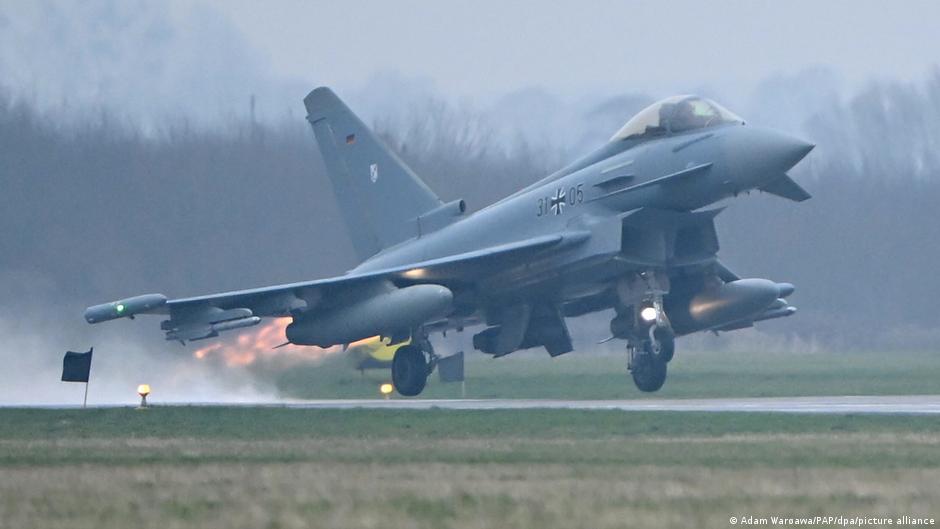
Germany has moved four Eurofighter jets to Latvia for a little more than a week, a deployment timed to cover the country’s parliamentary elections on October 3 and to support NATO’s integrated air and missile defense system. The aircraft, from the Bundeswehr’s 74th Tactical Air Wing based at Neuburg an der Donau, have been transferred to the Lielvarde military airfield in central Latvia, according to Latvia’s defense ministry.
The mission is limited in duration, but its economic and strategic significance is broader. Latvia’s request for support from NATO allies came against the background of repeated violations of Baltic airspace. In practical terms, the dispatch of high-end combat aircraft to guard the skies during an election illustrates how democratic continuity, military readiness and the investment burden of collective defense have become inseparable on NATO’s northeastern flank.
Latvian Prime Minister Andris Kulbergs called the German response “a concrete sign of NATO solidarity” and of a shared commitment to protecting Latvia’s airspace and the security of its population.
Kulbergs thanked Germany on X for its “readiness to help and close cooperation.” His remarks framed the deployment not as a symbolic gesture alone, but as an operational contribution to public security at a politically sensitive moment. For Latvia, a small open economy on the alliance’s external border, the assurance that national airspace can be monitored and defended during an election is part of a wider stability equation.
Air Defense as Political Infrastructure
NATO has protected the airspace of Estonia, Latvia and Lithuania since the three Baltic states joined the alliance in 2004. That mission was designed to compensate for the limited fighter-aircraft capacity of the Baltic countries themselves. The arrangement was, from the outset, both military and economic: rather than each Baltic state building a full independent combat air force, allies rotated capabilities through the region under a collective security framework.
The current German deployment shows how that model has evolved. Since the start of Russia’s full-scale war against Ukraine, drones have repeatedly entered the airspace of the Baltic states. In August, NATO fighter jets shot down a drone that had violated Latvian airspace. Such incidents have raised the operational tempo of air policing and increased the political value of rapid allied reinforcement.
For investors and policymakers, the lesson is that air defense is no longer a narrow military category. It functions as a form of political infrastructure, protecting not only territory but also the institutional routines on which economic confidence depends. Elections, budget cycles, energy planning and cross-border trade all assume a baseline of security. When that baseline is challenged, the cost is not limited to defense ministries; it spreads into risk premiums, public spending priorities and the long-term allocation of capital.
The Baltic Deterrence Balance Sheet
The presence of four Eurofighters for just over a week will not by itself transform Latvia’s defense posture. But it is part of a larger balance sheet of deterrence. NATO’s model in the Baltics relies on shared assets, rotational deployments and the credibility of rapid response. Economically, that spreads the burden across the alliance while giving frontline states access to capabilities that would be difficult and costly to maintain alone.
Germany’s role is notable because the deployment reflects the use of advanced European defense assets in a region where the costs of insecurity are immediate. The Eurofighter is not being sent for an open-ended combat mission, but to strengthen airspace monitoring and support NATO’s integrated air and missile defense system during a defined period of heightened sensitivity. That distinction matters: deterrence often works through visible readiness rather than active engagement.
The Baltic states’ experience since 2004 also offers a historical parallel for small economies under strategic pressure. Their accession to NATO embedded them in a security structure that allowed defense needs to be met through collective mechanisms. After Russia’s full-scale invasion of Ukraine, however, the assumptions behind that structure have hardened. Airspace incidents involving drones have made the abstract promise of collective defense more operational, more frequent and more expensive.
Those costs include aircraft readiness, basing, crews, logistics and coordination across national command structures. The source announcement does not quantify the expense of the German deployment, but the pattern is clear: maintaining credible deterrence requires recurring commitments, not one-off announcements. For economies such as Latvia’s, the benefit is reduced exposure to destabilizing pressure. For larger allies such as Germany, the cost is the continued allocation of military resources to the eastern and northeastern flank.
A Longer Mission Ahead
The short Latvian deployment also foreshadows a longer German role in Baltic air policing. From December 2026, Eurofighters are again scheduled to take on NATO airspace surveillance from Estonian territory as part of the alliance’s Air Policing mission. Until March 2027, five Eurofighters, together with flight crews, are to be stationed at the Amari air base in northwestern Estonia.
That planned mission highlights the increasingly routinized nature of NATO’s presence in the region. What once might have been described as reassurance has become a standing feature of the Baltic security economy. Air policing rotations provide predictable coverage, but they also require sustained budgeting, trained personnel and political consensus among allies.
For Latvia, the arrival of German Eurofighters ahead of the October 3 parliamentary elections is therefore more than an episode in election security. It is a snapshot of a structural shift in Europe’s economic geography of defense. Border economies now carry a premium on resilience, and alliance members must decide how much military capacity they are willing to keep forward, mobile and ready.
The immediate mission is brief: four aircraft, based in Lielvarde, supporting NATO air and missile defense for just over a week. The deeper consequence is more durable. In the Baltic region, the security of democratic processes, the credibility of allied commitments and the economics of deterrence are converging into a single policy problem.