US Envoys Seek Direct Russia-Europe Track in Ukraine Peace Talks
Washington is preparing a new multilateral round as it seeks to align negotiations with Europe’s long-term security and economic interests.
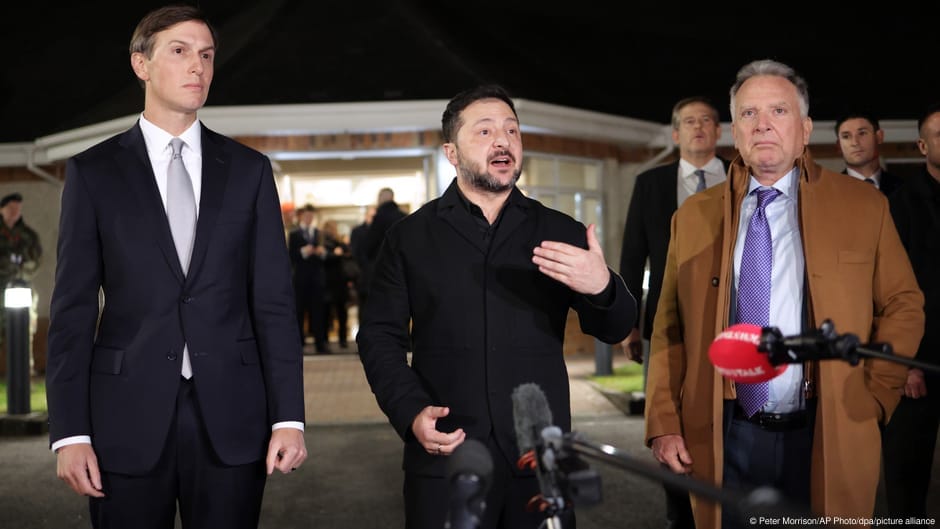
US presidential envoys Steve Witkoff and Jared Kushner are working to facilitate direct engagement between Moscow and European partners as negotiations over the war in Ukraine move toward a broader and potentially more consequential phase.
Kushner said on Saturday, November 14, that the effort covers both the Ukraine peace process and discussions about security across the continent. Preparations have also begun for another round of talks, following a week of meetings involving Russian, Ukrainian and US representatives.
The planned inclusion of European officials represents more than a diplomatic adjustment. Any settlement would affect defense spending, investment risk, energy policy and reconstruction across the region. A negotiation involving only Russia, Ukraine and the United States could address immediate military questions, but its implementation would inevitably depend on European governments that finance Ukraine, enforce sanctions and manage much of the continent’s security architecture.
Europe’s Economic Stake in a Security Settlement
Kushner linked the effort to NATO’s continuing role, arguing that the alliance, whose members include the United States and European countries, will remain a central pillar of European security. That position suggests Washington sees a durable settlement as inseparable from the institutions expected to support it.
“Any final agreement must be approved by all interested parties,” Kushner said, adding that President Donald Trump would support only arrangements that strengthen the security of Ukraine and Europe and reduce the likelihood of future conflicts.
For European economies, the durability of an agreement would be as important as its immediate terms. A fragile ceasefire could leave governments facing persistently high defense costs while businesses continue to price in geopolitical risk. A settlement regarded as credible by all major parties could provide a firmer basis for capital allocation, infrastructure planning and eventual reconstruction. The negotiations therefore concern not only the cessation of hostilities but also the long-term distribution of security costs.
The emphasis on direct Russia-Europe dialogue also reflects a structural reality: Europe would bear many of the consequences of either success or failure. Governments across the continent must balance military preparedness with fiscal pressures and competing domestic spending demands. Bringing European representatives into the process could make negotiations more complex, but it could also reduce the risk of an agreement whose political or financial obligations lack sufficient support.
Practical Compromises and a Wider Format
Kushner said another strand of work involves preparing the agenda for the next trilateral round involving Russia, the United States and Ukraine. According to him, both Moscow and Kyiv recognize that practical compromises will be required to end the war.
He also said several new ideas emerged during talks held over the past week and that some could produce a breakthrough. He did not disclose their substance. The absence of detail leaves unresolved how the parties might approach the central political, territorial and security questions, but the reference to practical compromises indicates that the discussions are being framed around measures capable of implementation rather than declarations of principle alone.
The diplomatic sequence has been intensive. On November 10 and 11, Kushner and Witkoff represented Washington at trilateral talks in Abu Dhabi with delegations from Moscow and Kyiv. On November 12, the two envoys travelled to Russia for a meeting with President Vladimir Putin. They arrived in Dublin the following day and met Ukrainian President Volodymyr Zelensky.
That itinerary placed the United States in a central intermediary role while maintaining separate channels with both belligerents. The proposed European participation would broaden that structure and could help connect any preliminary understandings to the governments expected to sustain a future security framework.
The next meeting has not been publicly scheduled. Before leaving Moscow, however, Kushner told the Russian television programme Vesti that new discussions would take place “as early as next week” and would use a multilateral format. Witkoff likewise said the date had already been fixed and confirmed that European representatives would attend.
From Negotiation to Economic Credibility
The expansion from a trilateral channel to a multilateral one may slow bargaining because more participants bring additional interests and constraints. Yet it could strengthen the economic credibility of any eventual agreement. Commitments involving security guarantees, reconstruction finance or changes to existing restrictions would require political consent and sustained implementation across several jurisdictions.
For markets and businesses, diplomatic momentum alone is unlikely to remove uncertainty. The more consequential signal would be whether the talks establish a framework that governments can finance, enforce and preserve over time. Kushner’s focus on approval by all interested parties implicitly acknowledges that a settlement without institutional backing could prove economically costly even if it temporarily reduces military activity.
The coming round will therefore test whether the latest proposals can bridge immediate wartime demands and Europe’s longer-term security structure. The reported recognition in Moscow and Kyiv that compromise is necessary may create room for progress. The participation of European representatives will show whether that room can be converted into a settlement carrying the political and economic support needed to endure.